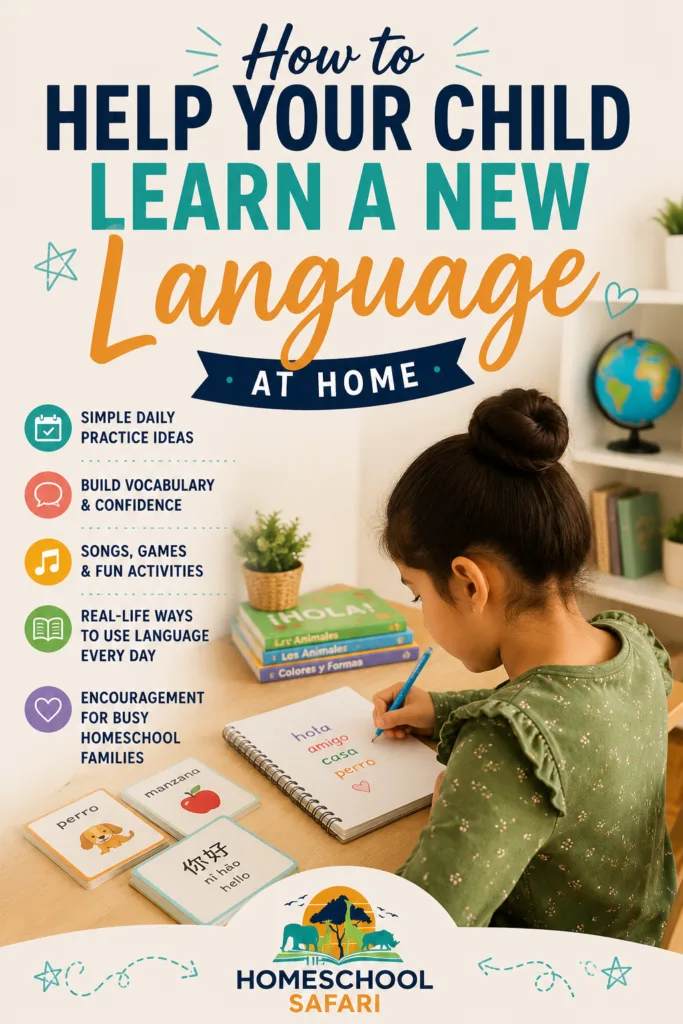
How to Successfully Help Your Child Learn a New Language at Home
Updated by Khara Sandoval, Co-Founder of The Homeschool Safari, formerly Little Lions Learn.
This post was originally published as a Little Lions Learn language learning article and has been updated to reflect Homeschool Safari’s current Spanish, Mandarin, live class, curriculum, and homeschool support options.
Many homeschool parents want their children to learn a second language, but they are not always sure where to begin.
You may wonder:
- Can my child learn a language if I do not speak it myself?
- Is a workbook enough?
- How do we practice pronunciation?
- How do I make language learning fun instead of stressful?
- How can my child actually use the language in conversation?
The good news is that you do not have to know everything before your child begins. You can learn together, use simple practice routines, and get support from live language classes where your child can hear, speak, and practice with a real teacher and other students.
Homeschool Safari helps students practice Spanish and Mandarin through live conversation, group classes, parent support, and homeschool resources. Language learning does not have to be another subject you avoid. With the right plan, it can become one of the most enjoyable parts of your homeschool week.
Can My Child Learn a Second Language at Home?
Yes, children can learn a second language at home, especially when they have consistent practice, exposure to the language, and opportunities to speak.
Many families think they need a full language curriculum, a fluent parent, or hours of daily study before they can begin. That is not true. Your child can start small.
A few minutes a day can help your child build confidence with:
- Vocabulary
- Greetings
- Songs
- Listening skills
- Pronunciation
- Simple phrases
- Short conversations
- Cultural awareness
The key is consistency. A child who practices a little every day will usually make more progress than a child who practices for a long time once in a while.
What Is the Most Important Thing When Learning a New Language?
Practice is one of the most important parts of learning a new language.
We often hear the phrase “practice makes perfect,” but a better way to say it is “practice makes progress.” Your child does not have to speak perfectly to grow. They need repeated chances to hear, say, use, and remember the language.
Think about athletes, dancers, musicians, chefs, or chess players. They improve because they practice. Language learning works the same way.
For homeschool families, a realistic goal is about 10–20 minutes of language practice a day. This does not have to be formal workbook time. Practice can happen in short, simple moments throughout the day.
How Can Homeschool Families Practice a Language Without Adding More Stress?
You do not have to completely change your schedule to help your child practice Spanish or Mandarin. Language practice can fit into routines you already have.
Practice in the Car
Car time can become language time.
You can:
- Listen to children’s songs in Spanish or Mandarin
- Review flashcards at stoplights
- Play “I Spy” using color words or object names
- Practice greetings
- Count cars, signs, or objects
- Let siblings quiz each other
If your child is learning Spanish, you might practice colors, numbers, foods, animals, or simple phrases. If your child is learning Mandarin, you might practice greetings, numbers, family words, or basic classroom phrases.
The goal is not to turn every drive into school. The goal is to make the language familiar.
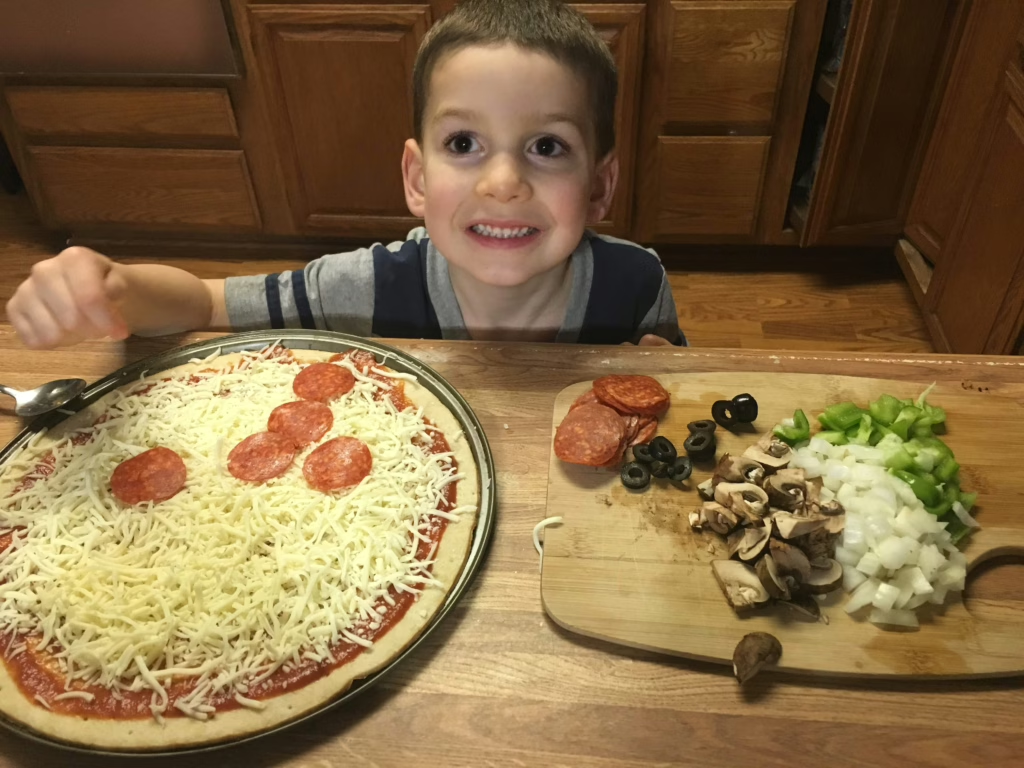
Practice While Cooking
Cooking gives children many chances to use language naturally.
You can practice:
- Food words
- Colors
- Numbers
- Measuring words
- Actions like stir, mix, cut, pour, and eat
- Simple questions like “What is this?” or “How many?”
If you do not know a word, look it up together. That is part of the learning process. You are showing your child that learning is not about knowing everything already. It is about being willing to grow.
Practice During Bath Time or Daily Routines
You can practice language during simple routines like bath time, getting dressed, cleaning up, or bedtime.
Try practicing:
- Body parts
- Colors
- Toys
- Clothing
- Household items
- Simple commands
- Songs
- Counting
For younger children, songs and movement work especially well because they connect language to action.
Label Items Around the House
One simple way to build vocabulary is to label items in your home.
You can label:
- Door
- Window
- Table
- Chair
- Bed
- Book
- Wall
- Floor
- Kitchen
- Bathroom
- Toys
- Food items
Seeing the words often helps children become more familiar with them. You can point to the labels during the day and say the words together.
Practice at Bedtime
If you already read before bed, add a small language routine.
You can:
- Read a simple bilingual book
- Listen to an audiobook
- Review five vocabulary words
- Sing a short song
- Count objects in the room
- Say goodnight in the new language
Keep it short and calm. Bedtime practice should feel peaceful, not stressful.
What Should Parents Do If They Do Not Speak the Language?
If you do not speak Spanish or Mandarin, you can still support your child.
You do not have to be the only teacher. You can help by creating routines, encouraging practice, reviewing vocabulary, and giving your child access to live language support.
This is where live classes can make a big difference.
A live teacher can help students:
- Hear correct pronunciation
- Practice speaking out loud
- Respond to questions
- Use vocabulary in conversation
- Learn from classmates
- Build confidence
- Stay accountable
For homeschool families, this is especially helpful because it gives children the conversation practice that can be hard to create with a book or app alone.
Why Is Live Conversation Practice So Helpful?
A workbook can introduce vocabulary. An app can provide repetition. A video can model words and phrases.
But language is meant to be used with people.
Live conversation helps children move from memorizing words to actually using them. When students practice with a teacher and a group of kids, they hear real language, respond out loud, and learn that mistakes are part of the process.
Conversation practice also helps children become less shy. The more they speak, the more confident they become.
Homeschool Safari offers Spanish and Mandarin learning opportunities where students can practice with a live teacher and other students in an encouraging online setting.
How Can Parents Keep Language Learning Fun?
Language learning should not feel like punishment. Children are more likely to keep going when practice feels enjoyable, meaningful, and manageable.
Here are some ways to keep it fun.
Keep Lessons Short
Short lessons are often better than long, stressful ones.
For younger children, start with 5–10 minutes. For older children, 15–20 minutes may be enough. If your child becomes overwhelmed, take a break and come back later.
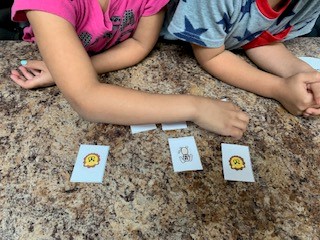
Turn Practice Into a Game
Games make repetition feel less boring.
Try:
- Memory games
- Flashcard races
- Matching games
- Charades
- Bingo
- “I Spy”
- Scavenger hunts
- Timed vocabulary challenges
- Drawing and labeling pictures
You can also make your own games using words your child is learning.
Sing Songs and Move
Songs are powerful for language learning because they help children remember sounds, rhythm, and vocabulary.
You can use:
- Greeting songs
- Counting songs
- Color songs
- Animal songs
- Movement songs
- Clean-up songs
Movement helps children connect words to actions, which makes learning more memorable.
Laugh and Let Mistakes Happen
It is normal to mispronounce words or forget vocabulary. Children need to know that mistakes are not failure. They are part of learning.
Keep the mood light. Celebrate effort. Encourage your child to try again.
What Should Parents Avoid When Teaching a New Language?
Avoid making language learning stressful.
Children may shut down if they feel embarrassed, rushed, or corrected too harshly. Instead of yelling or pressuring them, try slowing down.
Helpful responses include:
- “Let’s try that again.”
- “Good effort.”
- “That sound is tricky. Let’s practice it together.”
- “You remembered part of it!”
- “Let’s take a break and come back.”
Language learning takes time. Encouragement matters.
How Can Children Use the Language in Real Life?
Children remember language better when they use it in real situations.
You can encourage your child to:
- Greet family members in the new language
- Order food using a practiced phrase
- Count objects around the house
- Name foods while cooking
- Label items in their room
- Sing songs during routines
- Practice with classmates in a live class
- Teach a sibling a new word
- Record themselves saying a short phrase
Using the language helps it become part of daily life instead of just another worksheet.
What If My Child Feels Shy Speaking a New Language?
Many children feel shy at first. Adults often do too.
Start small. Your child does not need to have a full conversation right away. They can begin with one word, one phrase, one greeting, or one answer.
Live group classes can help because students see other children trying too. They learn that everyone is practicing and growing.
Confidence comes with repetition.
How Can Families Set Language Learning Goals?
Goals help children see progress.
Start with simple goals like:
- Learn 10 new words
- Practice greetings for one week
- Count to 20
- Learn a song
- Label 10 items in the house
- Practice for 10 minutes a day
- Attend a live class consistently
- Use one new phrase during the week
Let your child help choose the goal. When children have ownership, they are more likely to stay motivated.
Celebrate progress when they meet a goal. The reward does not have to be expensive. It can be a movie night, a special snack, extra game time, or simply sharing their progress with family.
Does Learning a Language Help With Other Subjects?
Language learning can support many areas of development. It can strengthen listening, memory, attention, problem-solving, reading connections, and cultural understanding. Check out ACTFL for more information on the researched benefits of language learning.
It can also give children a productive brain break from subjects that feel difficult. For example, a child who struggles in math may enjoy practicing Spanish or Mandarin through songs, movement, or conversation.
Language learning does not have to take away from core subjects. When done in short, consistent routines, it can enrich the homeschool day.
How Does Homeschool Safari Support Language Learning?
Homeschool Safari helps homeschool families by offering support that goes beyond a book or app.
Our language learning support may include:
- Spanish classes
- Mandarin classes
- Live teachers
- Group conversation practice
- Vocabulary practice
- Songs and games
- Listening and speaking practice
- Parent support
- Printable and digital resources
- Homeschool community support
We also support families with math, ELA, curriculum, live classes, private classes, and parent resources.
Our goal is to help families homeschool with more confidence and less overwhelm.
Where Should Families Start?
If you want your child to learn Spanish or Mandarin, start small.
Choose one simple routine this week:
- Practice five words a day
- Listen to one song in the language
- Label five items in your home
- Practice greetings at breakfast
- Watch a short lesson
- Join a live class
- Use a flashcard game
- Read a bilingual book
You do not have to do everything at once. Just begin.
If you want more support, Homeschool Safari can help your child practice Spanish or Mandarin with live teachers, group classes, homeschool resources, and parent support.
Frequently Asked Questions
Can my child learn Spanish or Mandarin if I do not speak the language?
Yes. A parent does not have to be fluent for a child to begin learning. Parents can support practice at home, and live teachers can help with pronunciation, conversation, and structured learning.
Is a workbook enough to learn a second language?
A workbook can help with vocabulary and written practice, but children also need listening and speaking practice. Live conversation gives students a chance to use the language with real people.
How much time should my child practice a language each day?
A simple goal is 10–20 minutes a day. Younger children may need shorter practice sessions, while older students may be ready for longer practice.
What languages does Homeschool Safari teach?
Homeschool Safari offers Spanish and Mandarin language learning opportunities for homeschool students.
How can I make language learning less stressful?
Keep practice short, use games and songs, celebrate effort, take breaks when needed, and avoid correcting in a way that embarrasses your child.
Does Homeschool Safari only offer language classes?
No. Homeschool Safari also supports families with math, ELA, curriculum, live classes, private classes, printable and digital resources, parent support, and community.
Final Thoughts: You Can Help Your Child Learn a New Language
Helping your child learn a new language at home does not have to be overwhelming. You can start with simple routines, make practice fun, and give your child opportunities to use the language in real conversation.
Practice, make it fun, use the language. Go for it!
Do not stop, don’t make it stressful and finally do not let fear or busyness hold you back.
Your child can begin learning Spanish or Mandarin at home, and you do not have to do it alone.
Homeschool Safari is here to help families make language learning more interactive, supported, and joyful.