If your child hates reading, they may not actually hate books. They may hate feeling unsuccessful, corrected, embarrassed, or overwhelmed. Start by making reading feel safe again, choosing easier books on purpose, reading aloud, and identifying which part of reading is hard: decoding, fluency, comprehension, confidence, or interest.
If your child says, “I hate reading,” it can feel heavy as a homeschool parent. You may wonder if you are behind, if you missed something important, or if your child will always struggle with books.
But that statement is not the end of the story.
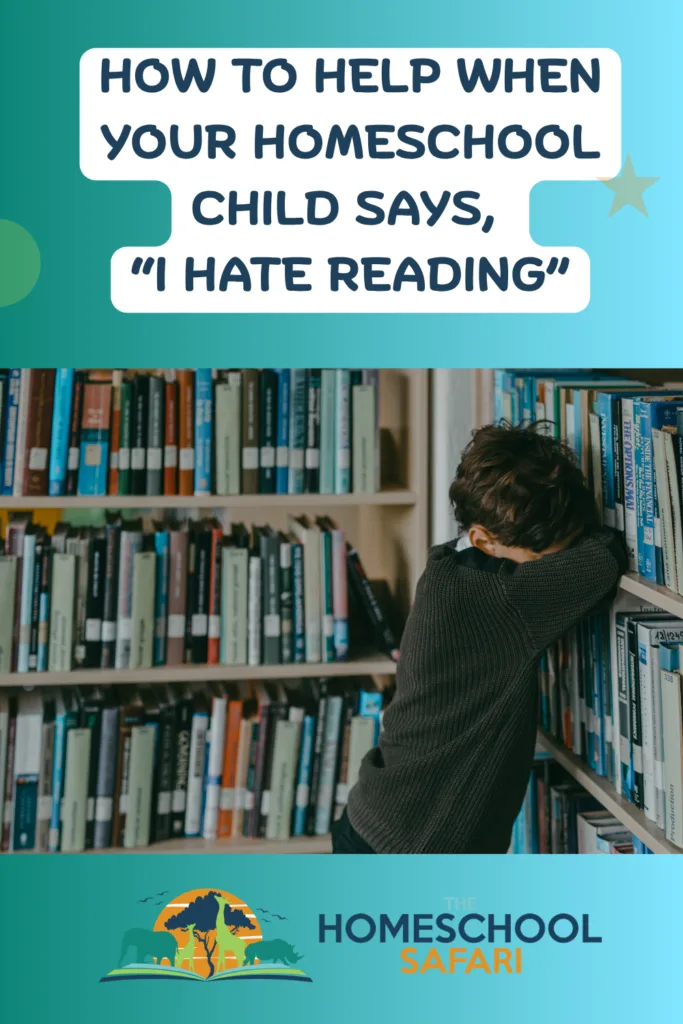
When a child says they hate reading, it is usually a clue. Reading may feel too hard, too embarrassing, too boring, or too pressured. Your child may be tired of being corrected, frustrated by books that feel too difficult, or unsure how to explain which part of reading feels hard.
The goal is not simply to force more reading. The goal is to rebuild confidence and find out what kind of support your child actually needs.
Why Do Some Kids Say They Hate Reading?
Children may say they hate reading for many different reasons. Some struggle to sound out words. Some can read the words but feel exhausted by the effort. Some read fluently but do not understand what they read. Others feel embarrassed, rushed, corrected, or uninterested in the books they are given.
That is why it helps to slow down and look for the real problem. A child who cannot decode words needs a different kind of help than a child who understands the words but lacks confidence. A child who is bored needs a different approach than a child who feels ashamed.
When a child says, “I hate reading,” try hearing it as, “Something about reading feels hard for me.” That perspective allows you to respond with support instead of pressure.
Stop Turning Every Reading Moment Into a Test
Reading can accidentally become a constant performance. A child sits down with a book, and the parent immediately begins correcting, prompting, asking questions, and checking comprehension. “Sound that out.” “Try again.” “What is that word?” “What happened on this page?” “What is the main idea?”
Those skills matter. Phonics, fluency, vocabulary, and comprehension are all important. But if every reading moment feels like a test, some children begin to dread books altogether. They feel watched, corrected, and pressured every time they open a page.
One of the best things you can do is create reading moments that are not tests. Read aloud just for enjoyment. Let your child listen to audiobooks. Let them look at graphic novels, joke books, animal books, mysteries, cookbooks, magazines, or books connected to their interests.
This does not mean you stop teaching reading skills. It means you also protect your child’s relationship with stories, language, and books. You are not only teaching skills. You are helping your child rebuild the identity of, “I am a reader.”
Figure Out Which Part of Reading Is Hard
Reading is not one skill. It is a group of skills working together. When a child struggles, we need to stop asking only, “Why won’t they read?” and start asking, “Which part of reading is breaking down?”
For some children, the issue is decoding. They struggle to sound out words, guess often, skip words, or become frustrated quickly. If decoding is the problem, your child may need more phonics support, practice with word patterns, or review of foundational sounds.
For others, the issue is fluency. They can read the words, but it is slow, choppy, and exhausting. In that case, short rereading practice, familiar books, and modeled fluent reading can help.
Some children struggle with comprehension. They can say the words on the page, but they do not fully understand what they read. These children may need shorter passages, frequent pauses, retelling practice, and discussion.
For some children, the issue is confidence. They are so afraid of being wrong that they would rather avoid reading entirely. Others may simply lack interest because they have not found books that feel meaningful to them yet.
The solution depends on the problem. A child who cannot decode needs something different from a child who can read the words but does not understand the passage. A child who is embarrassed needs a different approach than a child who is bored.
Finding the real problem helps you choose the right next step.
Choose Easier Books on Purpose
Easy books are not a failure. If your child is struggling with reading, do not only hand them harder books. Give them books they can actually read with success.
This may feel like going backward, but it is not. Easy books build fluency, confidence, and momentum. They help a child experience the feeling of, “I can do this.”
If every book feels like a mountain, your child is going to avoid climbing. But if reading begins to feel possible again, your child may become more willing to try.
Let your child reread a favorite book. Let them read below their grade level sometimes. Let them choose books that feel fun, funny, interesting, or comforting. This does not mean you never challenge them. It means you give them enough success that they are willing to accept the challenge.
Confidence often comes before growth.
Keep Reading Aloud
Some parents stop reading aloud once their child can technically read independently. But reading aloud is still one of the most powerful things you can do, even for older children.
Read-alouds build vocabulary, listening comprehension, attention, background knowledge, and a love of story. They model fluent reading and allow children to enjoy books that may be above their independent reading level.
Listening to a good book still counts.
Reading aloud does not replace phonics or independent reading, but it supports the whole reading life of the child. If your child hates reading, do not remove stories from your home. Bring stories back in a low-pressure way.
Read during lunch, before bed, or in the car through audiobooks. Choose funny books, mysteries, adventure stories, animal books, historical fiction, or nonfiction topics your child already loves. Let books become enjoyable again, not just something to get through.
Make Reading Feel Safe Again
For some children, reading does not feel safe. They feel embarrassed, behind, corrected, or compared. When they say, “I hate reading,” they may really mean, “I hate feeling bad at reading.”
That is a different problem, and it needs a different response.
Instead of saying, “You just need to read more,” try saying, “We are going to make reading feel easier and calmer.” Instead of correcting every mistake instantly, give your child time. Instead of making them read too much at once, read one paragraph. Instead of pushing through tears, pause and come back later.
Measure growth from where your child is, not from where you wish they were. Shame does not create strong readers. Support, consistency, appropriate instruction, and confidence do.
How Homeschool Safari Can Help with Reading and ELA
Homeschool Safari helps K–6 homeschool families with live classes, curriculum support, and structured learning in subjects like ELA, reading, writing, and math.
At Homeschool Safari, ELA is not treated as just one skill. It includes phonics, reading fluency, comprehension, vocabulary, writing, grammar, and confidence. That can feel like a lot for one parent to carry alone.
Homeschool Safari offers live support and structured learning for families who want help with reading, writing, and language arts. Sometimes a parent needs help identifying the skill gap. Sometimes a child needs a teacher who can explain the concept in a different way. Sometimes the family needs structure so reading and writing do not become daily battles.
Support does not replace the parent. It supports the parent.
Final Thoughts
If your child says they hate reading, do not panic. Start by making reading feel safe again. Stop turning every reading moment into a test. Figure out which part of reading feels hard. Choose easier books on purpose. Keep reading aloud. Build confidence one small step at a time.
Your child can become a reader. They may need a different path, more support, or more confidence, but this is not the end of the story.
Need help with homeschool ELA?
Explore Homeschool Safari reading, writing, and ELA support for homeschool families.
Frequently Asked Questions About Kids Who Hate Reading
Why does my child hate reading?
Your child may hate reading because it feels too hard, too pressured, too embarrassing, or too boring. Many children who say they hate reading are actually struggling with decoding, fluency, comprehension, confidence, or interest.
Should I make my child read harder books?
Not always. If your child is struggling, easier books can help rebuild fluency and confidence. Easy books are not a failure. They can be an important bridge back to successful reading.
Do audiobooks count as reading?
Audiobooks can support vocabulary, comprehension, background knowledge, and a love of stories. They do not replace phonics or independent reading practice, but they are a valuable part of a child’s reading life.
How can I help my child enjoy reading again?
Create low-pressure reading moments. Read aloud, offer books connected to your child’s interests, choose easier books when needed, and avoid turning every reading time into a test.
Can Homeschool Safari help with reading and ELA?
Yes. Homeschool Safari supports K–6 homeschool families with live classes, curriculum, and structured learning support for reading, writing, grammar, vocabulary, comprehension, and other ELA skills.